
Azimuthal Averaging of Stellar Intensity#
Background#
The stellar intensity map from a YIP has real azimuthal structure, even for
radially symmetric (1d) coronagraphs. Airy rings and diffraction features
produce 70-90% azimuthal variation at moderate separations (e.g. r=10 pixels).
For yield calculations and integration time estimation, the azimuthally averaged stellar intensity at a given separation is typically desired rather than the raw position-angle-dependent value. This ensures that a planet’s background noise estimate depends only on its angular separation, not its arbitrary position angle.
Two Approaches#
Rotate-and-average (pyEDITH legacy)#
Rotate the 2D stellar intensity image through many angles and average:
from scipy.ndimage import rotate
import numpy as np

ntheta = 100
theta = np.linspace(0, 360, ntheta, endpoint=False)
result = np.zeros_like(istar_2d)
for angle in theta:
    result += rotate(istar_2d, angle, reshape=False, order=3)
result /= ntheta
This is conceptually simple but has several drawbacks:
Slow: 100 cubic interpolation passes (~0.4s per coronagraph)
Rotation artifacts: each
scipy.ndimage.rotatecall introduces cubic interpolation error that accumulates across rotationsResidual azimuthal structure: the averaged result is not perfectly symmetric, so the value at (r, PA=45deg) differs from (r, PA=47deg)
Radial profile projection (yippy)#
Bin pixels by radius, compute the mean in each annular bin, fit a 1D interpolator, and project back onto the pixel grid:
from yippy import Coronagraph

coro = Coronagraph(yip_path, psf_trunc_ratio=0.3)

# Already available: coro.core_mean_intensity(separation)
# To get a 2D map:
r_lod = coro.separation_map()  # (npix, npix) separations in lam/D
istar_az_avg = coro.core_mean_intensity(r_lod)
This approach:
Fast: a single vectorized interpolation call (~0.001s)
Artifact-free: no rotation interpolation artifacts
True azimuthal mean: mathematically exact average over all position angles, by definition
Perfectly symmetric: every pixel at the same radius gets the exact same value
Comparison#
Tested on usort_offaxis_ovc and eac1_aavc coronagraphs (256x256,
pixscale=0.25 lam/D), comparing within 32 lam/D:
Metric |
usort |
eac1 |
|---|---|---|
Rotate time (100 angles) |
0.424s |
0.422s |
Radial profile time |
0.001s |
0.001s |
Speedup |
365x |
424x |
Max relative difference |
1288% (1e-17 center) |
109% |
Mean relative difference |
3.0% |
3.4% |
The large max relative differences occur at near-zero-signal pixels close to the center where relative percentages blow up. The mean ~3% difference is real and originates from rotation interpolation artifacts in the rotate-and-average method.
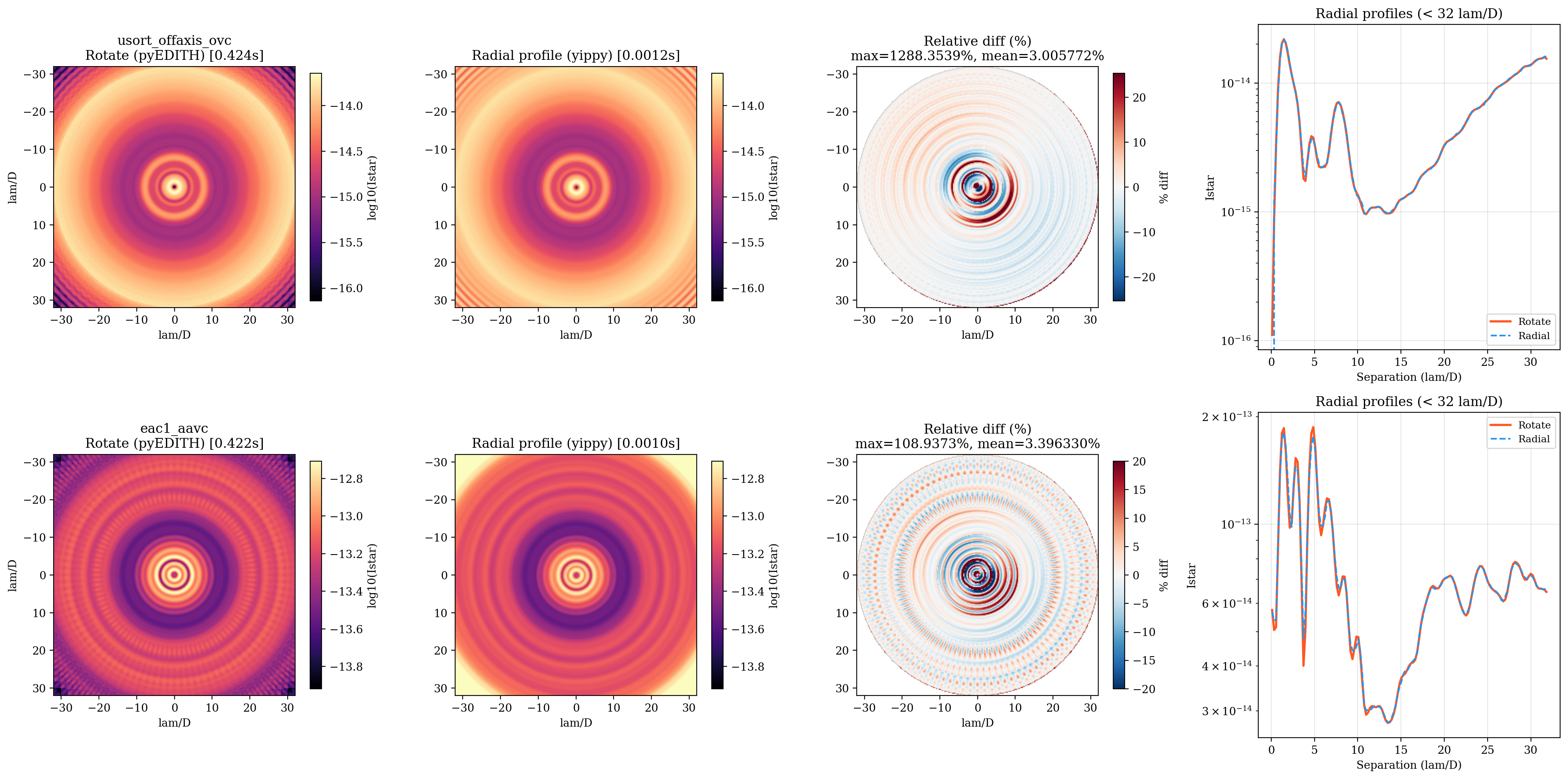
Left pair: 2D maps (log scale) from each method appear visually similar, with clear Airy ring structure. Third column: relative difference map reveals systematic ring-pattern offsets at Airy ring peaks/troughs. Right: radial profiles overlay, showing the radial profile method (blue dashed) produces a smoother curve than the rotate method (orange solid).
Radial Binning Parameters#
The radial profile uses floor(max(image_shape) / 2) bins (128 for a
256x256 image). Each bin spans ~1.4 pixels (~0.35 lam/D at pixscale=0.25),
giving ~3 bins per Airy ring spacing. This is adequate for capturing the
azimuthal average without tracking fine Airy ring oscillations, which is
desirable for the averaged quantity.
Recommendation#
Use yippy’s core_mean_intensity (radial profile) instead of the
rotate-and-average approach. It is faster, more accurate, and produces
cleaner azimuthal averages.
For the noise floor, divide by the post-processing factor:
noise_floor_ayo = coro.core_mean_intensity(separation) / ppf
See also: Noise Floor Conventions