
Performance Metrics Overview#
Coronagraph performance metrics bridge the gap between optical design and predicted scientific yield, ultimately determining the integration time required to detect or characterize an exoplanet.
This notebook provides a high-level dashboard of yippy’s performance metrics and shows how they feed into exposure time calculators (ETCs). For detailed theory and calculations, see the individual deep-dive notebooks:
Core Throughput – planet signal preservation
Stellar Leakage and Contrast – starlight suppression
Spatial Metrics and Backgrounds – PSF core size and background scaling
Noise Floors and Integration Time – systematic limits and ETC equations
Reference: Ruane et al. (2018) – Review of high-contrast imaging systems for current and future ground- and space-based telescopes I: coronagraph design methods and optical performance metrics
Reference: Stark et al. (2025) – Cross-Model Validation of Coronagraphic ExposureConfig Time Calculators for the Habitable Worlds Observatory
EXOSIMS utility: EXOSIMS provides its own YIP processing script,
process_opticalsys_package,
which computes throughput, core area, occulter transmission, and
core mean intensity from the same input files that yippy reads.
Acknowledgments#
Thank you to Susan Redmond for providing the AAVC coronagraph yield input package used throughout these demonstrations
Two ETC Families#
Two primary exposure time calculators consume yippy’s coronagraph data, and they use fundamentally different aperture strategies:
EXOSIMS |
AYO / pyEDITH |
|
|---|---|---|
Aperture |
Fixed circular (e.g., 0.7 \(\lambda/D\)) |
PSF truncation ratio (adaptive) |
Core Area |
Constant |
Varies with separation |
Stellar leakage |
Core Mean Intensity or Raw Contrast (fallback) |
Core Mean Intensity |
Noise floor |
Contrast units |
Intensity units |
Background factor |
1x (Nemati: RDI \(k_{SZ}\), \(k_{det}\)) |
2x (ADI subtraction) |
Metrics at a Glance#
Metric |
yippy accessor |
Description |
Units |
|---|---|---|---|
Core Throughput |
|
Fraction of planet flux inside photometric aperture |
dimensionless |
Raw Contrast |
|
Stellar leakage relative to peak planet flux in aperture |
dimensionless |
Occulter Transmission |
|
Sky transmission mask radial profile |
dimensionless |
Core Area |
|
Effective solid angle of the PSF core |
\((\lambda/D)^2\) |
Core Mean Intensity |
|
Azimuthally averaged stellar intensity at separation \(r\) |
dimensionless |
Noise Floor (EXOSIMS) |
|
\(\max(|C(r)|,\, C_{\rm floor}) / \text{ppf}\) |
dimensionless |
Noise Floor (AYO) |
|
\(\bar{I}_\star(r) / \text{ppf}\) |
dimensionless |
Matplotlib is building the font cache; this may take a moment.
/home/docs/checkouts/readthedocs.org/user_builds/yippy/envs/stable/lib/python3.12/site-packages/tqdm/auto.py:21: TqdmWarning: IProgress not found. Please update jupyter and ipywidgets. See https://ipywidgets.readthedocs.io/en/stable/user_install.html
  from .autonotebook import tqdm as notebook_tqdm
Downloading file 'eac1_aavc_2d.zip' from 'https://github.com/CoreySpohn/yippy/releases/download/data-v2/eac1_aavc_2d.zip' to '/home/docs/.cache/yippy'.
Unzipping contents of '/home/docs/.cache/yippy/eac1_aavc_2d.zip' to '/home/docs/.cache/yippy/eac1_aavc_2d.zip.unzip'
Coronagraph: eac1_aavc_2d (Amplitude Apodized Vortex Coronagraph, generated by Susan Redmond)
IWA: 4.26 λ/D
OWA: 32.00 λ/D
Summary Panel#
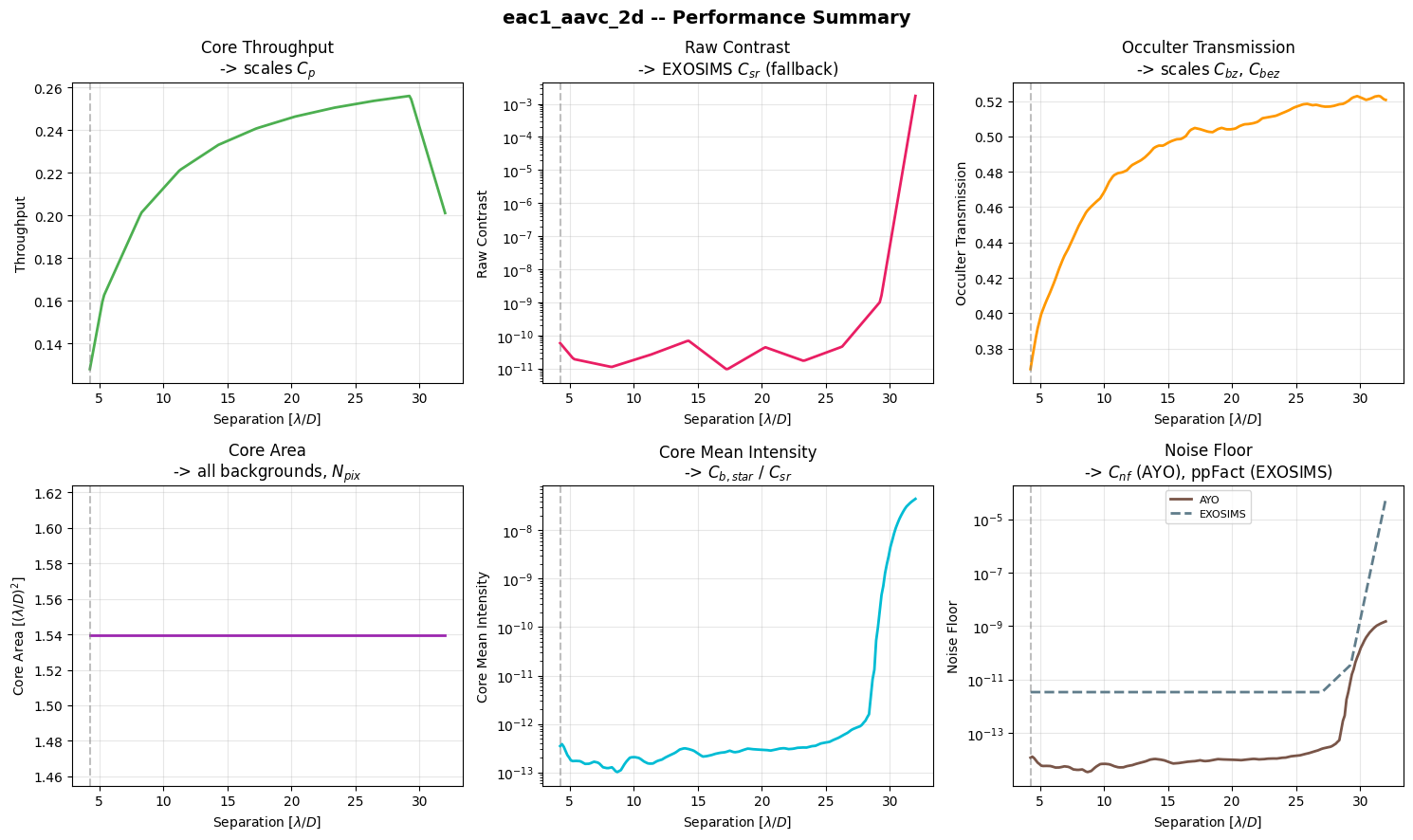
How Metrics Feed Into ETCs#
EXOSIMS Integration Time#
where \(\bar{c}_{sp} = \bar{c}_{sr} \cdot \text{ppFact} \cdot \text{stabilityFact}\) is the photon rate of the speckle residual that fundamentally cannot be subtracted. Uses the fixed circular aperture mode.
Nemati Module
The equation above describes EXOSIMS’s default OpticalSystem, where
\(\bar{c}_b\) is a simple sum of noise terms. The Nemati optical system
module adds reference differential imaging (RDI) factors \(k_{SZ}\) and
\(k_{det}\) that scale speckle/zodi and detector backgrounds respectively,
based on the fraction of time spent on a reference star (ref_Time) and
the reference star’s brightness difference (ref_dMag). See
EXOSIMS.OpticalSystem.Nemati for details.
AYO / pyEDITH Integration Time#
where the factor of 2 accounts for ADI background subtraction. Uses the PSF truncation aperture mode.