Core Throughput#
Core throughput measures how much of the planet’s light survives the coronagraph and lands in the photometric aperture. It directly scales the planet count rate in the ETC.
Theory#
Coronagraphic PSF#
The coronagraphic PSF \(\text{PSF}_{\text{coro}}(x, x_0, \lambda)\) is the system response with all coronagraph masks in place and the system optimized to suppress starlight in the dark hole. Unlike a conventional PSF, it varies with the off-axis source position \(x_0\).
Absolute Throughput#
Coronagraph throughput \(\eta_p\) is the fraction of available planet light detected. It is computed by integrating \(\text{PSF}_{\text{coro}}\) centered on \(x_0\) over the photometric aperture \(\text{AP}(x_0)\):
In the ETC, throughput directly scales the planet count rate \(C_p\).
API: Use compute_throughput_curve() to get
throughput as a function of separation, or the stored interpolator
via coro.throughput(separation).
from yippy.performance import compute_throughput_curve
seps, throughputs = compute_throughput_curve(coro, aperture_radius_lod=0.7)
# Or use the interpolator directly:
tp = coro.throughput(8.0) # throughput at 8 lam/D
/home/docs/checkouts/readthedocs.org/user_builds/yippy/envs/stable/lib/python3.12/site-packages/tqdm/auto.py:21: TqdmWarning: IProgress not found. Please update jupyter and ipywidgets. See https://ipywidgets.readthedocs.io/en/stable/user_install.html
from .autonotebook import tqdm as notebook_tqdm
Coronagraph: eac1_aavc_2d (Amplitude Apodized Vortex Coronagraph, generated by Susan Redmond)
Pixel scale: 0.25 λ/D / pix
IWA: 4.26 λ/D, OWA: 32.00 λ/D
Fixed Circular Aperture#
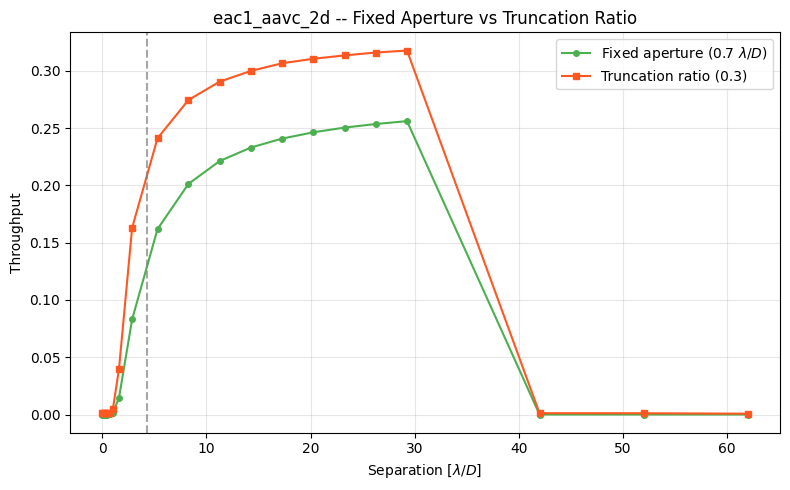
The default approach uses a fixed circular aperture (typically 0.7 \(\lambda/D\)) centered on the PSF peak at each off-axis position. This is the standard method used by EXOSIMS.
Calculation Walkthrough#
The compute_throughput_curve function:
Iterates over each off-axis PSF position along the x-axis
Extracts and oversamples a subarray around the PSF peak
Places a circular aperture centered on the PSF peak
Sums the flux inside the aperture (PSF is normalized to 1)
The animation below shows this process at each PSF position, building up the throughput curve point by point.
Throughput Curve#
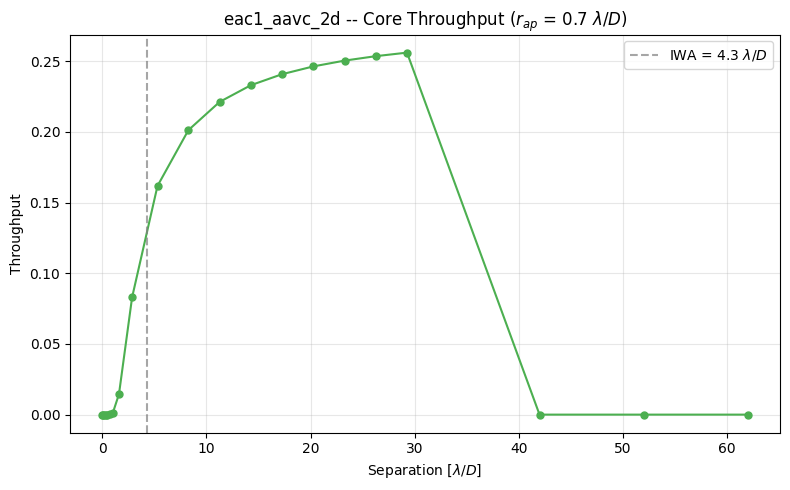
Number of PSF positions: 21
Throughput range: [0.0000, 0.2560]
Aperture Radius Effect#
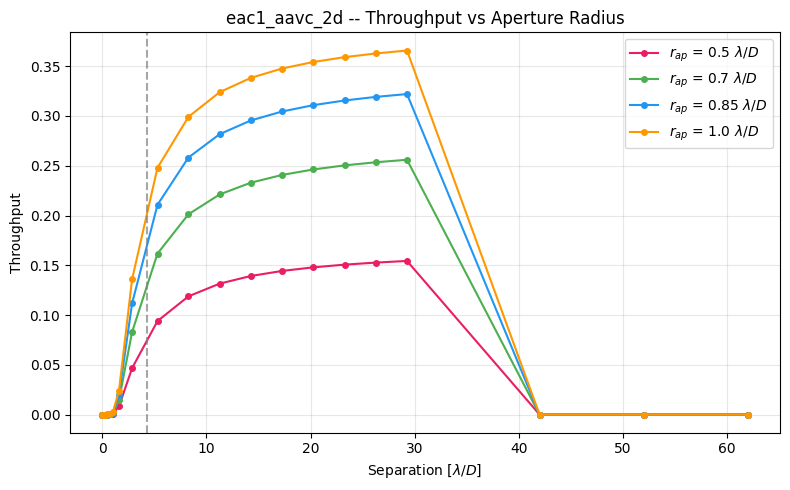
The choice of aperture radius affects throughput directly. Larger apertures capture more planet flux (higher throughput) but also more background and stellar leakage. This tradeoff is explored in the contrast notebook.
PSF Truncation Ratio (AYO Mode)#
AYO uses a fundamentally different aperture strategy: instead of a fixed circular aperture, it selects all pixels where the PSF exceeds a fraction of its peak value. This adaptive aperture changes shape and size with separation.
AYO’s ETC loops over multiple truncation ratios and picks the one that minimizes integration time at each separation.
Truncation Mask Animation#
The animation below shows the truncation mask (red contour) sweeping through PSF positions. Unlike the fixed circular aperture, the mask shape adapts to the PSF structure at each separation.
Fixed Aperture vs Truncation Ratio Comparison#